
Flex & Force
Showing all 5 results
-
Flex & Force, Sensors
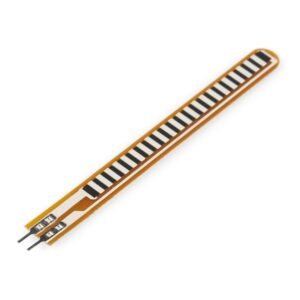
Flex Sensor 2.2 Inch
2.2-inch resistive flex sensor for measuring relative bend in Arduino-compatible wearables, robotics, controls and motion experiments. Resistance increases as the active strip bends. Secure the base, use a voltage-divider circuit and avoid creasing or repeatedly flexing the connector area.
SKU: n/a -
Flex & Force, Sensors
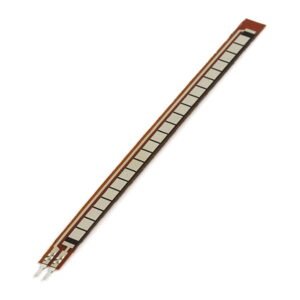
Flex Sensor 4.5″
4.5-inch resistive flex sensor for Arduino-compatible bend, posture, wearable-control and robotics experiments. Resistance increases as the active strip bends. Read it through a voltage-divider circuit, calibrate it in the finished assembly and protect the base and connector from sharp bends or repeated strain.
SKU: n/a -
Flex & Force
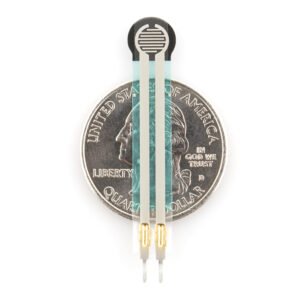
Force Sensitive Resistor – Small
This is a small force-sensitive resistor. It has a 0.16″ (4 mm) diameter active sensing area. This FSR from Interlink Electronics will vary its resistance depending on how much pressure is being applied to the sensing area. The harder the force, the lower the resistance. When no pressure is being applied to the FSR, its resistance will be larger than 1MΩ, with full pressure applied the resistance will be 2.5kΩ.
Two pins extend from the bottom of the sensor with a 0.1″ pitch making it breadboard-friendly.
These sensors are simple to set up and great for sensing pressure, but they aren’t incredibly accurate. Use them to sense if it’s being squeezed, but you may not want to use it as a scale.
SKU: SEN584 -
Flex & Force, Sensors
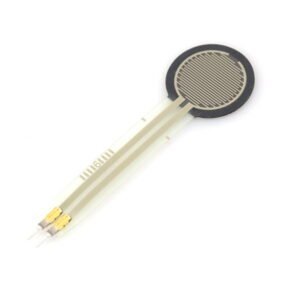
Force Sensitive Resistor 0.5 INCH FSR
Thin 0.5-inch force-sensitive resistor for detecting relative touch and pressure in Arduino-compatible controls, robotics and interface prototypes. Resistance decreases as force is applied to the active circular area. Use a voltage-divider circuit and application-specific calibration; this sensor is not a precision weighing load cell.
SKU: n/a -
Arduino & IOT Boards, Flex & Force, Sensors
FSR402 Force Sensitive Resistor FSR
The FSR is made of 2 layers separated by a spacer. The more one presses, the more of those Active Element dots touch the semiconductor and that makes the resistance go down. FSRs are basically a resistor that changes its resistive value (in ohms Ω) depending on how much it is pressed. These sensors are fairly low cost, and easy to use but they’re rarely accurate. They also vary some from the sensor to sensor perhaps 10%. So basically when you use FSRs you should only expect to get ranges of response. While FSRs can detect weight, they’re a bad choice for detecting exactly how many pounds of weight are on them. However, for most touch-sensitive applications like “has this been squeezed or pushed and about how much” they’re a good deal for the money!
SKU: n/a